

Bài dạy Tiếng Anh Lớp 8 - Unit 10: Recycling (cont.) - Năm học 2019-2020
 9 trang
03/01/2026
700
9 trang
03/01/2026
700
Bạn đang xem tài liệu "Bài dạy Tiếng Anh Lớp 8 - Unit 10: Recycling (cont.) - Năm học 2019-2020", để tải tài liệu gốc về máy hãy click vào nút Download ở trên.
Tóm tắt nội dung tài liệu: Bài dạy Tiếng Anh Lớp 8 - Unit 10: Recycling (cont.) - Năm học 2019-2020
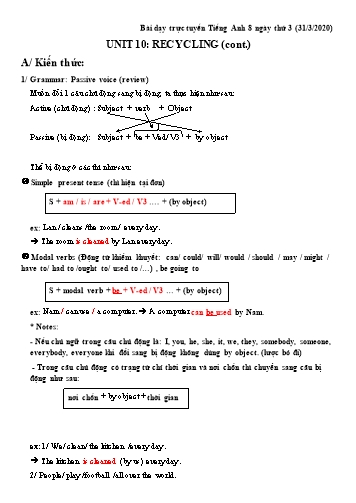
Bài dạy trực tuyến Tiếng Anh 8 ngày thứ 3 (31/3/2020) UNIT 10: RECYCLING (cont.) A/ Kiến thức: 1/ Grammar: Passive voice (review) Muốn đổi 1 câu chủ động sang bị động, ta thực hiện như sau: Active (chủ động) : Subject + verb + Object Passive (bị động): Subject + be + Ved/ V3 + by object Thể bị động ở các thì như sau: Simple present tense (thì hiện tại đơn) S + am / is / are + V-ed / V3 . + (by object) ex: Lan / cleans /the room/ every day. The room is cleaned by Lan every day. Modal verbs (Động từ khiếm khuyết: can/ could/ will/ would / should / may / might / have to/ had to /ought to/ used to /) , be going to S + modal verb + be + V-ed / V3 + (by object) ex: Nam / can use / a computer. A computer can be used by Nam. * Notes: - Nếu chủ ngữ trong câu chủ động là: I, you, he, she, it, we, they, somebody, someone, everybody, everyone khi đổi sang bị động không dùng by object. (lược bỏ đi) - Trong câu chủ động có trạng từ chỉ thời gian và nơi chốn thì chuyển sang câu bị động như sau: nơi chốn + by object + thời gian ex: 1/ We/ clean/ the kitchen /every day. The kitchen is cleaned (by us) every day. 2/ People/ play /football /all over the world. 3. We clean the kitchen every day. The kitchen ___________________________________________ 4. Miss Hong teaches English this year. English _______________________________________________ 5. You find oil in the Middle East. Oil __________________________________________________ 6. People grow potatoes everywhere now. Potatoes ______________________________________________ 7. They use tree leaves to wrap things. Tree leaves ____________________________________________ 8. They use garbage to make fertilizer. Garbage _______________________________________________ 9. People throw millions of old car tires away every year. Millions of _____________________________________________ 10.People grow rice in many countries. Rice __________________________________________________ 11.The young pioneers send many cans to factories for recycling. Many cans 12.The milkman brings bottles of milk to houses. Bottles of milk 13.They make lots of cars in Germany. Lots of cars 14.You see adverts on TV. Adverts 15.Nam doesn’t prepare his lessons carefully before class. Nam’s lessons 16.Does your country export rice to Britain? Is 17.People don’t plant tea in Northern Europe. Tea 18.Some people scatter the tea leaves on the tray. The tea leaves 19.Students often use computers in schools today. Computers 20.People use milk for making butter and cheese. Milk * Modal verbs: 1. People can recycle car tires to make pipes and floor coverings. Car tires _______________________________________________ 2. You must do this exercise carefully. II/ WORD FORM: 1. This pen is . You can throw it away. ( use ) 2. Add the eggs to a . ( mix ) 3. , the injured passengers were taken to hospital. ( immediate ) 4. Compost is a wonderful natural . It helps plant now. ( fertilize ) 5. Miss Black is one of from Friends of the Earth. ( represent ) 6. An is a person who is interested in or studies the environment and who tries to protect it from being damaged by human being. ( environment ) 7. They try their best to reduce the level of pollution. ( environment ) 8. The country’s resources include forests, coal and oil. ( nature ) 9. Reduce means not buying products which are . (over-package) ) 10.Contact an like Friends of the Earth for information. ( organize ) 11.If we reuse and recycle bottles and cans, we will protect the . (environ ) 12.Share your story with our readers! ( recycle ) 13.Attractive can help to sell products. ( package ) 14.Two from the group “Friends of the Earth” are talking to the students. ( represent ) 15.My father is talking to some volunteer . ( environment ) DẶN DÒ: - HS ôn lại công thức bị động (simple present tense & modal verb). - Làm hết bài tập câu bị động và nộp lại cho GV. - Học Word form bài 10 và làm bài tập word form. ********************************************************************** - Grammar: 1/ Adjective + to infinitive ( to V) Sử dụng cấu trúc này với 1 số tính từ như sau: difficult, easy, hard, impossible, dangerous (nguy hiểm), safe, expensive, cheap, interesting, happy, glad, pleased,) e.g.: a/ I’m very glad to see you. (Tôi rất vui được gặp bạn.) b/ It’s very difficult to find a good job here. (Thật là khó để tìm được việc làm tốt ở đây.) c/ This street is very dangerous to go alone at night. (Con đường này rất nguy hiểm để đi một mình vào buổi tối.) 2/ Adjective + Noun clause Cấu trúc này có thể sử dụng với 1 số tính từ như sau: glad, pleased, sorry, afraid, anxious, e.g.: a/ They are very pleased that their son passed his exam. Noun clause (Họ rất vui khi con trai họ thi đậu.) b/ I’m afraid that I can’t come to your party. (Tôi e rằng tôi không thể đến bữa tiệc của bạn được.) B/ Exercise: I. Structure: Adj + to infinitive 1. I am happy. I passed all the exams. I am 2. We are going to clean the environment. We are ready. We are 3. Keeping people form littering is very difficult. It is 4. They hear about the plan to collect the used boxes. They are surprised. They are 5. Being able to live in a clean environment is lucky. It is 6. She must empty the kitchen garbage. She is not pleased. A. sit B. to sit C. sat D. sitting 5. Household and garden waste is collected compost. A. to do B. to make C. to have D. to change 6. Empty cans are brought back to the factory for . A. recycling B. recycled C. recycle D. being recycled 7. These newspapers by that factory every day. A. prints B. printed C. are printed D. were printed 8. It is very dangerous fast in a crowded area. A. driving B. drive C. drove D. to drive 9. I am very pleased you have done it perfectly. A. for B. that C. how D. with 10.The new school in the village next month. A. is finished B. was finished C. will be finished D. has been finished 11.We can reuse the plastic bottles after they are with water. A. washed B. wash C. washing D. washing up 12.When somebody gets fainting, leave him or her flat. A. lie B. lying C. lay D. laying 13.We don’t know the name of the injured person. A. sterile B. burned C. wounded D. unconscious 14.Why do people in some areas dry tea leaves? – to keep mosquitoes away. A. heat B. fry C. burn D. cook 15.Farmers collect household and garden waste to make . A. compost B. floor coverings C. pipes D. glassware 16.What do they garbage for? A. do B. make C. recycle D. use 17.One of the solutions to reduce the shopping garbage is using . A. plastic bags B. cloth bags C. wood bags D. shopping bags 18.The organization shows us how the environment. A. protect B. protecting C. be protected D. to protect 19.Empty cans are brought back to the factory for . A. recycling B. recycled C. recycle D. be recycled 20.One ton of paper saves about eight trees. A. recycling B. recycled C. recycle D. being recycled DẶN DÒ: - HS học từ vựng + ngữ pháp bài 10. - Làm hết bài tập I,II,III
File đính kèm:
- bai_day_tieng_anh_lop_8_unit_10_recycling_cont_nam_hoc_2019.docx


