

Bài tập ôn tập English 9 - Unit 7: Saving energy
 7 trang
18/01/2026
550
7 trang
18/01/2026
550
Bạn đang xem tài liệu "Bài tập ôn tập English 9 - Unit 7: Saving energy", để tải tài liệu gốc về máy hãy click vào nút Download ở trên.
Tóm tắt nội dung tài liệu: Bài tập ôn tập English 9 - Unit 7: Saving energy
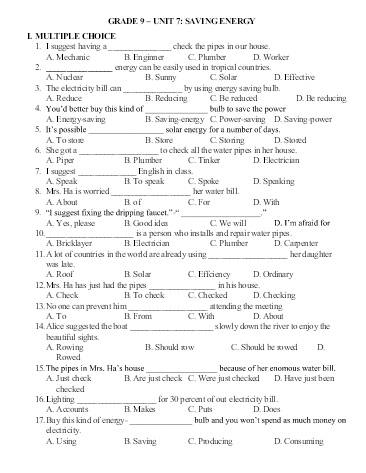
 GRADE 9 – UNIT 7: SAVING ENERGY
I. MULTIPLE CHOICE
 1. I suggest having a _______________ check the pipes in our house.
 A. Mechanic B. Enginner C. Plumber D. Worker
 2. ________________ energy can be easily used in tropical countries.
 A. Nuclear B. Sunny C. Solar D. Effective
 3. The electricity bill can ______________ by using energy saving bulb.
 A. Reduce B. Reducing C. Be reduced D. Be reducing
 4. You’d better buy this kind of _______________ bulb to save the power
 A. Energy-saving B. Saving-energy C. Power-saving D. Saving-power
 5. It’s possible __________________ solar energy for a number of days.
 A. To store B. Store C. Storing D. Stored
 6. She got a ___________________ to check all the water pipes in her house.
 A. Piper B. Plumber C. Tinker D. Electrician
 7. I suggest ______________ English in class.
 A. Speak B. To speak C. Spoke D. Speaking
 8. Mrs. Ha is worried ___________________ her water bill.
 A. About B. of C. For D. With
 9. “I suggest fixing the dripping faucet.”-“ ___________________.”
 A. Yes, please B. Good idea C. We will D. I’m afraid for
 10. _____________________ is a person who installs and repair water pipes.
 A. Bricklayer B. Electrician C. Plumber D. Carpenter
 11. A lot of countries in the world are already using ___________________ her daughter
 was late.
 A. Roof B. Solar C. Effciency D. Ordinary
 12. Mrs. Ha has just had the pipes ________________ in his house.
 A. Check B. To check C. Checked D. Checking
 13. No one can prevent him ___________________ attending the meeting
 A. To B. From C. With D. About
 14. Alice suggested the boat ____________________ slowly down the river to enjoy the
 beautiful sights.
 A. Rowing B. Should row C. Should be rowed D.
 Rowed
 15. The pipes in Mrs. Ha’s house _________________ because of her enomous water bill.
 A. Just check B. Are just check C. Were just checked D. Have just been
 checked
 16. Lighting ___________________ for 30 percent of out electricity bill.
 A. Accounts B. Makes C. Puts D. Does
 17. Buy this kind of energy- _______________ bulb and you won’t spend as much money on
 electricity.
 A. Using B. Saving C. Producing D. Consuming 8. They discovered something _____________________ in the discussion about”how to
 save energy” (interest)
 9. Mr. John is displased that his secretary solved the problem _________________ (effect)
 10. Food, clothing and shelters are all ___________________________ of life. (need)
 11. The internet made him _____________________________________. (interest)
 12. Let’s have an _____________________ mend the iron. (electric)
 13. The tablets work more __________________________ if you take a hot drink after
 them. (effect)
 14. There is a ________________________ faucet in your kitchen. (drip)
 15. What is the purpose of the _________________________ scheme? (label)
 16. I am ________________________ that all of them can speak french. (surprise)
 17. In sweden, most of the houses will be _____________ by solar energy soon. (hot)
 18. I’m pleased that you solved the problem ________________________. (effect)
 19. Look! There’s a ____________________ of water on your book. (drip)
 20. __________________ energy is the best alternative source of energy. (sun)
 III. TRUE / FALSE:
 Passage 1:
 Energy is very important in our modern life. People use energy to run machines,
heat and cool their homes, cook, give light, transport people and products from place to place.
Most energy nowadays comes from fossil fuels - petroleum, coal and natural gas. However,
burning fossil fuels causes pollution. Also, if we don't find new kinds of energy, we will use up
all the fossil fuels in the twenty-first century.
 Scientists are working to find other kinds of energy for the future. What might these sources of
 energy be?
 1. Energy is collected for use only in their homes.
 2. We bum coal to produce electricity.
 3. Air pollution comes from the burning of fossil fuels.
 4. Scientists aren't doing research into alternative energy sources.
 5. What's the passage mainly about?
 A. Fossil fuels B. Coal and gas C. Solar energy D. Kinds of energy.
 6. What is UNTRUE about the text?
 A. Energy is important in our everyday life.
 B. Most energy comes from fossil fuels.
 C. Fossil fuels are renewable sources of energy.
 D. Scientists are looking for alternatives of energy for the future.
 Passage 2:
 Many people still believe that natural resources will never be used up. Actually, the world's
 energy resources are limited. knows exactly how much fuel is left. However, we also
 should use them economically and ty to find out alternative sources of power. According to
 Professor Marvin Burnham of the New England of Technology, we have to start
 conserving coal, oil and gas before it is too late; and nuclear power is the only alternative.
 1. Natural resources will never run out.
 2. We don't know exactly how much fuel is left. 14. A. is B. are C. has D. have
 15. A. necessities B. luxuries C. resources D. appliances
 16. A. and B. because C. but D. so
 17. A. used B. spent C. saved D. wasted
 18. A. bills B. accounts C. wastes D. counters
 Passage 2:
 Are you looking for a cheap, clean, effective source of power that doesn't cause (13)
 _________ or waste natural resources? Look no further than solar energy (14)
 _________ the Sun. At present, most of our electricity comes from the use of coal, gas,
 oil or nuclear power. _________One percent of the solar energy that reaches the Earth is
 enough to provide power for the total population. Many countries (16) _________
 already using solar energy. Solar panels are placed on the roof of a house and the Sun's
 energy is used to heat water. The energy can be stored for a number of days, (17)
 _________ on cloudy days you can use solar energy, too. Sweden has an advanced solar
 energy program. There all buildings will be heated by solar energy and cars will use
 solar power instead (18) _________ gas by the year 2015.
 13. A. energy B. electricity C. garbage D. pollution
 14. A. on B. from C. in D. by
 15. A. prevented B. provided C. reduced D. polluted
 16. A. are B. have C. were D. will
 17. A. if B. because C. but D. so
 18. A. of B. in C. from D. with
 Passage 3:
 It is very important (13) _________ water carefully. Here are some (14) _________ to
 use less water. First, you should (15) _________ that you turn off the faucets tightly.
 They shouldn't (16) _________ in the bathroom or kitchen sink. Second, you shouldn't
 (17) _________ the water on for a long time. You should turn if off while you are doing
 something else. It should be (18)_________ while you are shaving or brushing your
 teeth. It should also be turned off while you are washing the dishes. Finally, in the
 summer you should water your garden in the evening.
 13. A to save B. to use C. to waste D. to reduce
 14. A. roads B. paths C. streets D. ways
 15. A. sure B. ensure C. surely D. unsure
 16. A. drip B. drop C. fail D. fall
 17. A. make B. keep C. get D. go
 18. A. on B. in C. at D. off
V. REARRANGE
 1. I think / public buses / if / it would / we use / be better /.
 _______________________________________________________________________
 2. To / can do / people’s health / polluted water / directly harm /.
 _______________________________________________________________________
 3. The faucets / Let’s / going out / all / turn off / before /.
 _______________________________________________________________________
 4. Run directly / let / into / the rivers / factory owners / the waste /. 19. Nam spent all his money on the trip to Ha Noi, so he had to borrow some from his
 friends
 Nam ran _______________________________________________________________
 20. All of the Vietnamese feel proud of the wonderful performance of the U23 players for
 the Asian Cup.
 All of the Vietnamese feel proud that the U23 players __________________________
 WORD FORM UNIT 7
No. Verbs nouns adjectives adverbs
 1 energy Energetic: năng động energetically
 2 Recent: gần đây Recently
 3 Enormousness Enormous: khổng lồ Enormously
 4 Crack: làm nứt Crack: vết nứt Cracked: bị nứt
 5 Drip: nhỏ giọt Dripping Dripping
 6 Suggest Suggestion Suggestive Suggestively
 7 Effect Effect (on): hiệu quả Effective: có hiệu quả Effectively
 8 Install: lắp đặt Installation: sự lắp đặt
 9 Luxury: sự xa xỉ Luxurious: xa xỉ Luxuriously
10 Need: cần thiết Necessity Necessary Necessarily
11 Consume: tiêu dùng Consumption: sự tiêu
 dùng
 Comsumer: người tiêu
 dùng
12 Product: sản xuất Production: sự sản xuất Productive Productively
 Product: sản phẩm
13 Replace: thay thế Replacement: sự thay Replaceable: có thể
 thế thay thế
14 Standardize: tiêu Standard: tiêu chuẩn Standard: chuẩn
 chuẩn hóa
15 Efficiency: tính hiệu quả Efficient: hiệu quả Efficiently
16 Compare: so sánh Comparison: sự so sáng Comparable: có thể so Comparably
 sánh Comparatively
 Comparative: tương đối
17 Ultimate: cuối cùng Ultimately
18 Innovate: đổi mới Innovation: sự đổi mới Innovative=innovatory Innovatively
19 Scheme: lên kế hoạch Scheme: kế hoạch Scheming
20 Label: dán nhãn Label: nhãn hiệu Labeling
File đính kèm:
- bai_tap_on_tap_english_9_unit_7_saving_energy.pdf


