

Bài tập Tiếng Anh Lớp 9 - Tuần 20 đến 24 - Bình An Junior High School
 7 trang
27/01/2026
360
7 trang
27/01/2026
360
Bạn đang xem tài liệu "Bài tập Tiếng Anh Lớp 9 - Tuần 20 đến 24 - Bình An Junior High School", để tải tài liệu gốc về máy hãy click vào nút Download ở trên.
Tóm tắt nội dung tài liệu: Bài tập Tiếng Anh Lớp 9 - Tuần 20 đến 24 - Bình An Junior High School
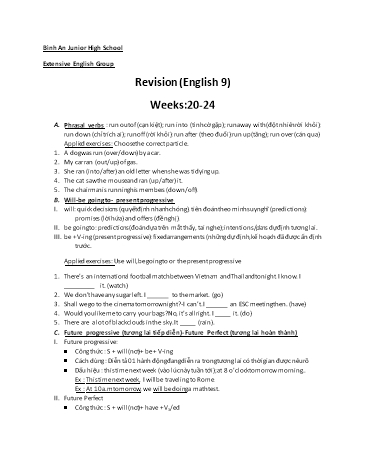
 Bình An Junior High School
Extensive English Group
 Revision (English 9)
 Weeks:20-24
 A. Phrasal verbs : run out of (cạn kiệt); run into (tình cờ gặp); run away with (đột nhiên rời khỏi);
 run down (chỉ trích ai); run off (rời khỏi); run after (theo đuổi); run up (tăng); run over (cán qua)
 Applied exercises: Choose the correct particle.
 1. A dog was run (over/down) by a car.
 2. My car ran (out /up) of gas.
 3. She ran (into/after) an old letter when she was tidying up.
 4. The cat saw the mouse and ran (up/after) it.
 5. The chairman is running his members (down/off).
 B. Will-be going to- present progressive
 I. will: quick decisions (quyết định nhanh chóng), tiên đoán theo mình suy nghĩ (predictions);
 promises (lời hứa) and offers (đề nghị).
 II. be going to: predictions (đoán dựa trên mắt thấy, tai nghe);intentions/plans dự định tương lai.
 III. be + V-ing (present progressive): fixed arrangements (những dự định, kế hoạch đã được ấn định
 trước.
 Applied exercises: Use will, be going to or the present progressive
 1. There’s an international football match between Vietnam and Thailand tonight. I know. I
 __________ it. (watch)
 2. We don’t have any sugar left. I _______ to the market. (go)
 3. Shall we go to the cinema tomorrow night?- I can’t. I _______ an ESC meeting then. (have)
 4. Would you like me to carry your bags? No, it’s all right. I _____ it. (do)
 5. There are a lot of black clouds in the sky. It _____ (rain).
 C. Future progressive (tương lai tiếp diễn)- Future Perfect (tương lai hoàn thành)
 I. Future progressive :
 • Công thức : S + will(not) + be + V-ing
 • Cách dùng : Diễn tả 01 hành động đang diễn ra trong tương lai có thời gian được nêu rõ
 • Dấu hiệu : this time next week (vào lúc này tuần tới); at 8 o’clock tomorrow morning...
 Ex : This time next week, I will be traveling to Rome.
 Ex : At 10 a.m tomorrow, we will be doing a math test.
 II. Future Perfect
 • Công thức : S + will(not) + have + V3/ed 2. Future wishes (ước tương lai) S + wish + S + would/could(not) + V1.....
 3. Past wishes (ước quá khứ) S + wish + S + would/could(not) + have + V3/ed.....
 Lưu ý : dấu hiệu ước ở hiện tại-quá khứ-tương lai
 Applied exercises : Put the verbs in the correct wishes.
 1. I wish I ________on the beach now. (be)
 2. If only I __________ her the truth yesterday. (not tell)
 3. If only I _________ fly to Paris when I grow up. (fly)
 4. I wish there ______ much traffic in this city. (not be)
 5. I wish I _______ Dalat last year. (visit)
 F. Must-have to
 1. must : phải (bắt buộc, mệnh lệnh, không làm bị phạt)
 musn’t : cấm, không được phép
 2. have to : cần phải
 don’t/ doesn’t/didn’t have to: không cần phải
 Applied exercises : Choose the correct modal verbs
 Burglars 1) must/must not be very careful if a Banryu is guarding your home. With a Banryu
robot you 2) don’t have to/must not worry about thieves while you are out. You 3)have to/ don’t have
to worry about fire either as it can sense smoke and high temperatures. If you 4) have to/ must not go
away and someone tries to break in, Banryu phones the emergency services and beams pictures to your
cell phone! ORDER YOUR BANRYU TODAY!
 G. Can/could/Be able to-May/Might
 Possibility
 He may come later. (It’s possible-50%)
 She might not be back before Tuesday. (It’s possible-40%)
 Ability
 He can/is able to swim fast. (has the ability-present)
 He could play tennis well. (had the ability in the past)
 He was able to win the race. (specific ability in the past)
 (NOT: He could win the race.)
 Permission
 Can I leave my bag here? (Is it OK if ...?-request)
 Could I use your cell phone? (Is it possible for me...?-more polite)
 May I sit here. (Could I ...?-more formal)
 Requests
 Can you help me with the bags? (Please, help me...)
 Could/Would you lend me your MP3 player? (more polite)
 Advice
 You must be careful with electricity. (strong advice)
 You should/ought to work harder. (advice)
 You could talk to him about it. (suggestion) Have you ever stopped (1)________ why people give each (2)________ eggs at Easter? The
 Christian festival of Easter celebrates the return of Jesus Christ from the death, but the festival is
 actually named (3)________ the goddess of the sun, Eostre, whose name is taken from the East
 where she (4)________. In very ancient times, Easter was a celebration that winter was (5)________
 and that a new life was about to begin. The rabbit, (6)_______ to the number of young it produces,
 is the symbol of life. In some parts of the world, the rabbit leaves large (7)_______ of eggs (another
 symbol of new life) in the garden and children have to find as many as they can. This is very
 (8)_______ Christmas when Santa Claus leaves presents for individual children. At Easter, childen
 have to be independent and (9)________ after themselves. In this (10)________ the hunt for Easter
 eggs represents the need for young people to go out into the world and make their own fortune.
 1. A. to wonder B. wondering C. wonder D. wander
 2. A. else B. person C. others D. other
 3. A. for B. about C. after D. with
 4. A. goes B. sets C. rises D. raises
 5. A. finish B. conclusion C. up D. over
 6. A. as B. since C. due D. because
 7. A. numbers B. sums C. figures D. totals
 8. A. like B. unlike C. different D. similar
 9. A. take B. get C. look D. carry
 10. A. day B. way C. habit D. time
 3) Read the passage and the questions or unfinished sentences. Then choose the answer-A,B,C,
 or D-that you think fits best.
 NOBEL
 Most people have heard of the Nobel Prize but do you know where the name comes from? The
prize is named after Alfred Nobel, a Swedish chemist who invented dynamite.
 Nobel was born in 1833 in Stockholm and studied in St. Petersburg, Russia and in the USA.
When he returned home, he worked in his father’s factory developing weapons and explosives. In 1864,
Alfred’s younger brother and four other people were killed in an explosion in the factory. After this,
Alfred dedicated his life to developing safer explosives. Three years later, he made dynamite which was
much more stable than any other explosive at that time. Nobel also invented severl other types of
explosive and he became very rich, owning factories all over the world. Nobel was worried about some of
the uses of his inventions and he spent a lot of time and money trying to promote world peace. He was
also very interested in science and literature and when he died in 1896, he wanted his money to be used to
set up the Nobel Prize. Each year this great honour is awarded to someone who has made a major
contribution to World Peace, Physics, Chemistry, Medicine, Economics and Literature.
 1. Alfred Nobel ________
 A. lived all his life in Russia and the USA.
 B. travelled abroad to study.
 C. had family in St. Petersburg. D. was not appreciated for her work.
 3. Her work made __________
 A. a big number of people want to help her.
 B. Mother Teresa rich by the year 2000.
 C. everyone argree with her.
 D. many people dislike her.
 4. Mother Teresa ___________
 A. died in 1979.
 B. was honoured for her work.
 C. died in France.
 D. was never well-known.
I. Writing :
 • Tham khảo 6.C, trang 64 (Student’s Book). Viết 01 bài luận văn đề nghị những gì học sinh
 nên làm để học tốt trong thời gian ở nhà để tránh đại dịch Covid-19 ( khoảng 100-120 từ)
 • Do as directed.
1. I don’t have a laptop.
 I wish
2. I’m not good at Maths, so I can’t help you.
 If I
3. Tom cut the flowers in the garden yesterday.
 The flowers
4. She didn’t finish her letter yesterday.
 She wishes she
5. Did she go to school yesterday?
 She went
File đính kèm:
- bai_tap_tieng_anh_lop_9_tuan_20_den_24_binh_an_junior_high_s.doc


