

Ôn tập kiến thức môn Tiếng Anh 7 - Unit 9: At home and away
 11 trang
22/02/2026
380
11 trang
22/02/2026
380
Bạn đang xem tài liệu "Ôn tập kiến thức môn Tiếng Anh 7 - Unit 9: At home and away", để tải tài liệu gốc về máy hãy click vào nút Download ở trên.
Tóm tắt nội dung tài liệu: Ôn tập kiến thức môn Tiếng Anh 7 - Unit 9: At home and away
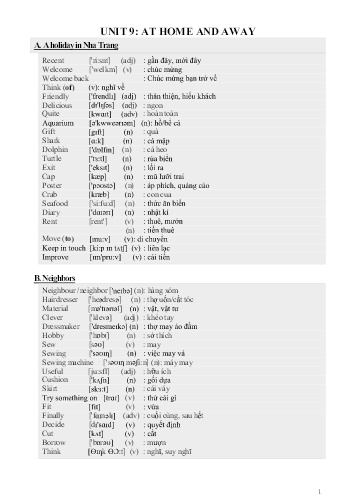
 UNIT 9: AT HOME AND AWAY
A. A holiday in Nha Trang
 Recent ['ri:snt] (adj) : gần đây, mới đây
 Welcome ['welkm] (v) : chúc mừng
 Welcome back : Chúc mừng bạn trở về
 Think (of) (v): nghĩ về
 Friendly ['frendlɪ] (adj) : thân thiện, hiếu khách
 Delicious [dɪ'lɪʃəs] (adj) : ngon
 Quite [kwɑɪt] (adv) : hoàn toàn
 Aquarium [ə'kwweərɪəm] (n): hồ/bể cá
 Gift [gɪft] (n) : quà
 Shark [ɑ:k] (n) : cá mập
 Dolphin ['dɒlfɪn] (n) : cá heo
 Turtle ['tɜ:tl] (n) : rùa biển
 Exit ['eksɪt] (n) : lối ra
 Cap [kӕp] (n) : mũ lưỡi trai
 Poster ['pəʊstə] (n) : áp phích, quảng cáo
 Crab [krӕb] (n) : con cua
 Seafood ['si:fu:d] (n) : thức ăn biển
 Diary ['dɑɪərɪ] (n) : nhật kí
 Rent [rent'] (v) : thuê, mướn
 (n) : tiền thuê
 Move (to) [mu:v] (v): di chuyển
 Keep in touch [ki:p ɪn tᴧtʃ] (v) : liên lạc
 Improve [ɪm'pru:v] (v) : cải tiến
B. Neighbors
 Neighbour /neighbor ['neɪbə] (n): hàng xóm
 Hairdresser ['heədresə] (n) : thợ uốn/cắt tóc
 Material [mə'tɪərɪəl] (n) : vật, vật tư
 Clever ['klevə] (adj) : khéo tay
 Dressmaker ['dresmeɪkə] (n) : thợ may áo đầm
 Hobby ['hɒbɪ] (n) : sở thích
 Sew [səʊ] (v) : may
 Sewing ['səʊɪƞ] (n) : việc may vá
 Sewing machine ['səʊɪƞ məʃi:n] (n): máy may
 Useful [ju:sfl] (adj) : hữu ích
 Cushion ['kᴧʃn] (n) : gối dựa
 Skirt [skɜ:t] (n) : cái váy
 Try something on [trɑɪ] (v) : thử cái gì
 Fit [fɪt] (v) : vừa
 Finally ['fɑɪnəlɪ] (adv) : cuối cùng, sau hết
 Decide [dɪ'sɑɪd] (v) : quyết định
 Cut [kᴧt] (v) : cắt
 Borrow ['bɒrəʊ] (v) : mượn
 Think [Ɵɪƞk ƟƆ:t] (v) : nghĩ, suy nghĩ
 1
 A. take/see B. took/ to see C. take/ to see D. took/
 see
 16. Be sure____________ him at half past six.
 A. telephone B. telephones C. to telephone D. telephones
 17. It’s ___________to collect stamps.
 A. interesting B. interest C. interested in D. interested
 18. I’d like _____________ you about my first day at work.
 A. to tell B. tell C. telling D. told
 19. Several decades ago, most people in my hometown _________ anything about the
 Internet.
 A. didn’t know B. don’t know C. won’t know D. not
 know
 20. It ___________ 2 hours to get to New York by coach.
 A. costs B. spends C. takes D. needs
Word form:
1 . Dave and I are old  ( friendly)
2. Did you make a . Go to Nha Trang ( decide)
3. This dictionary is very  for you to learn English.( use)
4. Covid 19 is a.. disease ( danger)
5. My family had a time last night . ( wonder )
6. Vietnamese people are very ..( friend)
7 Ms Lan. to buy a new dress last night.( decidedly)
8. My grandfather usually tells us a.. story ( fun)
9. Her children were hungry and .. after a long the trip.( tire)
10. Mrs Mai make her dress, so she is a..( dress)
11. John wore a shirt.( color)
12. She learned how to use a .. machine ( sew)
13. Her sister learned Spanish just for .. ( funny)
14. Liz has a big stamp.( collect)
15. Ba .. stamps as his hobby. ( collection)
16. My mother me a new bike last month. ( buy)
17. .., the dress fitted her very well.( final)
18. Liz thought the  little fish were the most beautiful.(color)
19. This is a busy shopping mall, full of activities and ( colored)
20. Mr & Mrs Robinson. fish and crap at a food stall last night.( eat)
 3
 PRESENT PROGRESSIVE TENSE (THÌ HIỆN TẠI TIẾP DIỄN)
1. FORM
 S + am/ is/ are + V-ing
 S + am/ is/ are + not + V-ing
 Am/ Is/ Are + S + V-ing ?
Trả lời:
 Yes, I + am. – Yes, he/ she/ it + is. – Yes, we/ you/ they + are.
 No, I + am not. – No, he/ she/ it + isn’t. – No, we/ you/ they + aren’t.
* LƯU Ý:
Thông thường ta chỉ cần cộng thêm “-ing” vào sau động từ. Nhưng có một số chú ý như
sau:
 Với động từ tận cùng là MỘT chữ “e”:
– Ta bỏ “e” rồi thêm “-ing”.
Ví dụ: write – writing type – typing come – coming
 Với động từ có MỘT âm tiết, tận cùng là MỘT PHỤ ÂM, trước là MỘT
 NGUYÊN ÂM
– Ta nhân đôi phụ âm cuối rồi thêm “-ing”.
Ví dụ: stop – stopping get – getting put – putting
2. SIGNAL WORDS
 Trong câu có các trạng từ chỉ thời gian:
– Now, right now, at the moment, at present
– At + giờ cụ thể (at 12 o’clock)
 Trong câu có các động từ như:
– Look! – Listen!– Keep silent!
Ví dụ:
– Now my sister is going shopping with my mother
– Look! The train is coming.
– Listen! Someone is crying.
 5
 vấn Yes, S + was/ were Yes, S+ did.
 No, S + wasn’t/ weren’t No, S + didn’t
 Ex: Ex:
 – Was she tired of hearing her customer’s – Did you visit Ho Chi Minh Museum
 complaint yesterday? with your class last weekend?
 – Were they at work yesterday? – Did he miss the train yesterday?
 Cách thêm “-ed” vào sau động từ:
 – Thông thường ta thêm “ed” vào sau động từ nhưng có một số chú ý sau:
 + Động từ tận cùng là “e” -> ta chỉ cần cộng thêm “d”.
 ex: type – typed/ smile – smiled/ agree – agreed
 + Động từ có MỘT âm tiết, tận cùng là MỘT phụ âm, trước phụ âm là MỘT
Lưu ý nguyên âm -> ta nhân đôi phụ âm cuối rồi thêm “-ed”.
 ex: stop – stopped/ shop – shopped/ tap – tapped
 + Động từ tận cùng là phụ âm + “y”
 → đổi “y” thành “i” rồi them “-ed”.
 Ví dụ: study – studied/ cry – cried
 2. SIGNAL WORDS
 – yesterday
 – last night/ last week/ last month/ last year
 – ago
 – in + thời gian ở quá khứ ( in 1990,  )
 EXERCISE
 I. Put the verbs in the simple past tense
 1. My sister (get) married last month.
 2. Daisy (come) to her grandparents’ house 3 days ago.
 3. My computer (be) broken yesterday.
 4. He (buy) me a big teddy bear on my birthday last week.
 5. My friend (give) me a bar of chocolate when I (be) at
 school yesterday.
 6. My children (not do) their homework last night.
 7. you here five years ago? (live)
 8. They (watch) TV late at night yesterday.
 9. your friend at your house last weekend? (be)
 7
 13. What _____________________ (you, do) next Sunday?
14. I ________________________ (not see) him playing soccer yesterday.
15.He __________________ (play) tennis badly before but now he (be) a good
tennis player.
16. She (spend) all her money last week.
17. The instructor ____________ (train) us badminton twice a week.
18. My father usually ___________ (drink) coffee but this morning he ___________
(drink) tea.
19. Last Sunday, Ba ____________ ( read ) books in the library.
20. We both (sleep) ____________________ badly that night.
21. The children (do) morning exercises at the moment.
22. What Hoa (do) yesterday morning?
 - She (sweep) the floor, (tidy) her room and (wash)
the dishes
23. Everybody (wait) for you now.
24. What the student (wear) at school two years ago?
25. Minh (brush) his teeth three times a day.
26. they (buy) a new car two days ago?
27. John and his father (build) ___________ the cabin themselves last year.
28. I hope you (come) .here soon.
29. Why you (leave) the party last night?
30. She never (stay) up late.
31. Last week. My mother (make) .a new shirt for me
32. Minh (go) to the dentist tomorrow morning.
33. My father (stop) smoking many years ago.
34. his uncle (take) him to see Tri Nguyen aquarium last week?
35. Dr.Lai (check) Minh's teeth at the moment.
36. Yesterday, my brother ____________ the first prize for his soccer team. (win)
37.We (study) French next month.
 9
 11) Remember to wake me up at 6.30 tomorrow morning.
 Don’t forget ....
12) I spent two hours watching that film last night.
 It
13) It took me twenty minutes to travel to the gas station.
 I ....
14) Nam likes watching cartoons.
 Nam is interested..
15) Children don’t really like to read books.
 Children are
16) I sent an email to my friend yesterday.
 My friend .
17) Don’t forget to turn the light off.
 Remember ....
18) My brother drinks less milk than me.
 I .
19) My father has more days off than my mother.
 My mother ....
20) I had a birthday present from my parents last week.
 My parents .
 11
File đính kèm:
- on_tap_kien_thuc_mon_tieng_anh_7_unit_9_at_home_and_away.pdf


