

Ôn tập kiến thức môn Tiếng Anh 9 - Unit 8: Celebrations
 13 trang
20/02/2026
340
13 trang
20/02/2026
340
Bạn đang xem tài liệu "Ôn tập kiến thức môn Tiếng Anh 9 - Unit 8: Celebrations", để tải tài liệu gốc về máy hãy click vào nút Download ở trên.
Tóm tắt nội dung tài liệu: Ôn tập kiến thức môn Tiếng Anh 9 - Unit 8: Celebrations
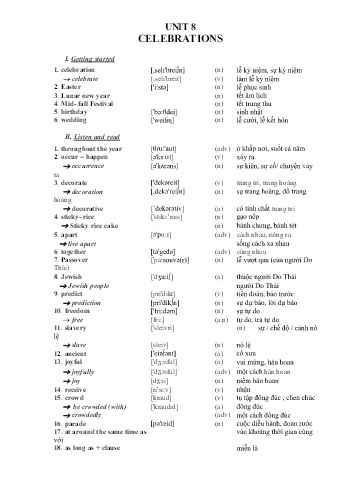
UNIT 8 CELEBRATIONS I. Getting started 1. celebration [,seli'brei∫n] (n) lễ kỷ niệm, sự kỷ niệm celebrate [,seli'breit] (v) làm lễ kỷ niệm 2. Easter ['i:stə] (n) lễ phục sinh 3. Lunar new year (n) tết õm lịch 4. Mid- fall Festival (n) tết trung thu 5. birthday ['bə:θdei] (n) sinh nhật 6. wedding ['wediη] (n) lễ cưới, lễ kết hụn II. Listen and read 1. throughout the year [θru:'aut] (adv) ở khắp nơi, suốt cả năm 2. occur = happen [ə'kɜ:(r)] (v) xảy ra occurrence [ə'kʌrəns] (n) sự kiện, sự cố/ chuyện xảy ra 3. decorate ['dekəreit] (v) trang trớ, trang hoàng decoration [,dekə'rei∫n] (n) sự trang hoàng, đồ trang hoàng decorative [´dekərətiv] (a) cú tớnh chất trang trớ 4. sticky- rice ['stiki 'rais] (n) gạo nếp Sticky rice cake (n) bỏnh chưng, bỏnh tột 5. apart [ə'pɑ:t] (adv) cỏch nhau, riờng ra live apart sống cỏch xa nhau 6. together [tə'geđə] (adv) cựng nhau 7. Passover ['pa:souvə(r)] (n) lễ vượt qua (của người Do Thỏi) 8. Jewish ['dʒu:i∫] (a) thuộc người Do Thỏi Jewish people người Do Thỏi 9. predict [pri'dikt] (v) tiờn đoỏn, bỏo trước prediction [pri'dik∫n] (n) sự dự bỏo, lời dự bỏo 10. freedom ['fri:dəm] (n) sự tự do free [fri:] (a,n) tự do, trả tự do 11. slavery ['sleivri] (n) sự / chế độ / cảnh nụ lệ slave [sleiv] (n) nụ lệ 12. ancient ['ein∫ənt] (a) cổ xưa 13. joyful ['dʒɔiful] (a) vui mừng, hõn hoan joyfully ['dʒɔiful] (adv) một cỏch hõn hoan joy [dʒɔi] (n) niềm hõn hoan 14. receive [ri'si:v] (v) nhận 15. crowd [kraud] (v) tụ tập đụng đỳc , chen chỳc be crowded (with) ['kraudid] (a) đụng đỳc crowdedly (adv) một cỏch đụng đỳc 16. parade [pə'reid] (n) cuộc diễu hành, đoàn rước 17. at around the same time as vào khoảng thời gian cựng với 18. as long as + clause miễn là 14. terrific [tə'rifik] (a) tuyệt vời 15. alive [ə'laiv] (a) cũn sống 16. quality [‘kwɔliti] (n) đức tớnh, phẩm chất 17. image [´imidʒ] (n) hỡnh ảnh imaginable [i´mổdʒinəbl] (n) cú thể tưởng tượng được 18. draw- ( drew- drawn) (v) rỳt ra VI. Write 1. image ['imidʒ] (n) hỡnh tượng, hỡnh ảnh 2. enhance [in'hɑ:ns] (v) tụn lờn, nõng lờn 3. support [sə'pɔ:t] (v) ủng hộ 4. nationwide ['nei∫nwaid] (adv) toàn quốc # world-wide khắp thế giới 5. share [∫eə] (v) chia sẻ 6. bring sb closer (v) mang ai đến gần gũi nhau hơn 7. Father’s Day (on the third Sunday in June) 8. Mother’s Day Mĩ ( on the second Sunday in May) Anh ( on the middle of March) GRAMMAR 1. Relative clauses (mệnh đề quan hệ) - Là mệnh đề phụ. - Bổ nghĩa cho danh từ đứng trước nú - Đứng ngay sau danh từ nú bổ nghĩa - Nối với mệnh đề chớnh bằng cỏc đại từ quan hệ : who, whom, which, whose, that. Who : Thay cho danh từ chỉ người, làm chũ ngữ hoặc tõn ngữ. Ex: - Viet is a boy who plays the guitar. ( Việt là cậu bộ chơi guitar) Who : thay cho ‘boy’, làm chủ ngữ cho động từ ‘ plays’ - The boy who we are looking for is Tom.( Cậu trai mà chỳng tụi đang tỡm là Tom.) Who : thay cho’ boy’, làm tõn ngữ cho động từ ‘ are looking for’ Whom : Thay cho danh từ chỉ người.Cú thể được dựng làm tõn ngữ thay cho who ( whom trang trọng hơn who) Ex : - The boy whom we are looking for is Tom..(Cậu trai mà chỳng tụi đang tỡm là Tom.) Which : Thay cho danh từ chỉ vật hoặc sự việc, làm chủ ngữ hoặc tõn ngữ. Chủ ngữ : Ex: - My brother works for a company which makes cars. ( Anh trai tụi làm cho một cụng ty mà chế tạo xe hơi) Which thay cho ‘company’, làm chủ ngữ cho ‘ makes’ Tõn ngữ : - Have you found the key which you lost ? ( Bạn đó tỡm thấy chỡa khoỏ mà bạn đó mất chưa?) adv clause of concession Although In spite of Though + S + V + N / V-ing = Even though Despite => mặc dự Ex: Although it rained heavily, I went to school. In spite of the heavy rain, I went to school. Ex : - Although I was tired, I tried to do my homework. ( Mặc dự tụi mệt, tụi cố gắng làm bài tập nhà) - We found a table, although the cafộ was crowded. ( Chỳng tụi tỡm được một cỏi bàn mặc dự quỏn đụng) * Note : sau IN SPITE OF / DESPITE cú thể dựng THE FACT THAT + clause Ex: In spite of the fact that it rained heavily, I went to school. EXERCISE _ UNIT 8 : CELEBRATIONS I. Listen and decide whether the statements are True or false: Exercise 1: 1. Vietnamese people usually decorate their house at Tet. 2. Vietnamese family members try to live apart at Tet. 3. Jewish people have a special meal called the Seder at Passover. 4. In many countries, there are parades on the streets at Easter. Exercise 2: 1. Tet occurs in late February. 2. One of special foods at Tet is sticky rice cake. 3. Passover is celebrated in Israel. 4. Easter day is on Sunday. II. Multiple choice: 1. - “I’ve just passed the final exam.” - “ ________________” A. Try harder next time B. Congratulations! C. Good luck D. It’s nice of you to say so 2. He finally won his ____________ after twenty years in prison. A. slavery B. slaver C. free time D. freedom A. Thanks. B. Sorry. C. Be quiet. D. Look at me. 2. What does this gesture mean? A. Okay! B. Well done! C. Congratulations! D. I’m here. 3. What does this sign mean? A. Playground is here. B. You can sit here. C. This is a picnic area. D. Go this way. 4. What does this man mean? A. I’m good. B. You are well. C. Thank you. D. Congratulations! 5. What does this sign mean? A. Clean your hand here B. I agree with you. C. Put your hand here. D. Do not enter. 6. Where can you see these signs? Winter Carnival Here in Saranac Lake, New York.It’s -5°C and people are (1)________their Winter Carnival. The festival takes (2)_______at the beginning of February each year and lasts 10 days. The local people build an enormous ice palace (3)_______a home for Sara ,the Snowy Owl, the town mascot. The festival begins with the crowning of the Winter Carnival King and Queen. Lots of fun events follow, including races and treasure hunts. Right now we are watching the (4)_________. There are dozens of colorful floats carrying people in (5)_________ costumes. The whole town comes alive. Tonight we’re watching the firework display over the Ice Palace. (6)_________ a “cool” celebration! 1. A. holding B. celebrating C. organizing D. reaching 2. A. place B. after C. part D. over 3. A. after B.for C. like D. as 4. A. birds B. firework C. parade D. treasure 5. A. fancy B. colorless C. black D.terrifing 6. A. How B. That C. Like D. What Reading 2 Day of the Dead (known as Dớa de Muertos in Spanish) is celebrated in Mexico (1)__________October 31st and November 2nd. On this holiday, Mexicans remember and honor their (2)________loved ones. It's not a gloomy or morbid occasion, rather it is a festive and colorful holiday celebrating the lives of those (3)________have passed on. Mexicans visit cemeteries, decorate the graves and spend time there, in the presence of their deceased friends and family members. They also make elaborately decorated altars (called ofrendas) in their homes to (4)__________ the spirits. The spirits are greeted with offerings of special foods and things that they enjoyed when they were alive. These are (5)_________on an altar in the family home. It is believed that the spirits consume the essence and the aroma of the foods that are offered. When the spirits depart, the living (6)________the food and share it with their family, friends, and neighbors. 1. A. on B. in C. between D. during 2. A. deceased B. living C. alive D. vital 3. A. when B. which C. who D. whom 4. A. welcome B. visit C. invite D. reach 5. A. taken out B. laid out C. put out D. hung out 6. A. consumed B. have consume C. consumes D. consume V.Reading comprehension: Read the following passage. Decide if the statements are True or False and choose the correct answers (A, B, C or D) Reading 1 The first Earth Day was in 1970. Gaylord Nelson, after seeing the damage done by a 1969 massive oil spill in Santa Barbara, California, was inspired to organize a national "teach-in" that focused on educating the public about the environment. Nelson recruited Denis Hayes, a politically active recent graduate of Stanford University, as national coordinator, and persuaded U.S. Rep. Pete McCloskey of California to be co-chairman. With a staff of 85, they were able to rally 20 million
File đính kèm:
- on_tap_kien_thuc_mon_tieng_anh_9_unit_8_celebrations.pdf


