

Ôn tập kiến thức môn Tiếng Anh Lớp 8 - Unit 10: Recycling
 13 trang
18/02/2026
420
13 trang
18/02/2026
420
Bạn đang xem tài liệu "Ôn tập kiến thức môn Tiếng Anh Lớp 8 - Unit 10: Recycling", để tải tài liệu gốc về máy hãy click vào nút Download ở trên.
Tóm tắt nội dung tài liệu: Ôn tập kiến thức môn Tiếng Anh Lớp 8 - Unit 10: Recycling
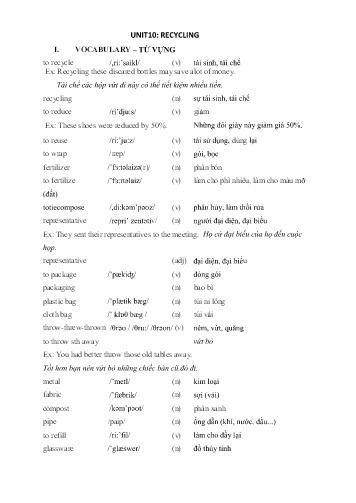
UNIT10: RECYCLING I. VOCABULARY – TỪ VỰNG to recycle /,ri:’saikl/ (v) tái sinh, tái chế Ex: Recycling these discared bottles may save alot of money. Tái chế các hộp vứt đi này cĩ thể tiết kiệm nhiều tiền. recycling (n) sự tái sinh, tái chế to reduce /ri’dju:s/ (v) giảm Ex: These shoes were reduced by 50%. Những đơi giày này giảm giá 50%. to reuse /ri:’ju:z/ (v) tái sử dụng, dùng lại to wrap /rỉp/ (v) gĩi, bọc fertilizer /’fɜ:təlaizə(r)/ (n) phân bĩn to fertilize /’fɜ:rtəlaiz/ (v) làm cho phì nhiêu, làm cho màu mỡ (đất) totỉecompose /,di:kəm’pəʊz/ (v) phân hủy, làm thối rửa representative /repri’ zentətiv/ (n) người đại diện, đại biểu Ex: They sent their representatives to the meeting. Họ cử đại biểu của họ đến cuộc họp. representative (adj) đại diện, đại biểu to package /’pỉkiʤ/ (v) đĩng gĩi packaging (n) bao bì plastic bag /’plỉtik bỉg/ (n) túi ni lơng cloth bag /’ klɒθ bỉg / (n) túi vải throw-threw-thrown /θrəʊ / /θru:/ /θrəʊn/ (v) ném, vứt, quăng to throw sth away vứt bỏ Ex: You had better throw those old tables away. Tốt hơn bạn nên vứt bỏ những chiếc bàn cũ đĩ đi. metal /’metl/ (n) kim loại fabric /’fỉbrik/ (n) sợi (vải) compost /kəm’pəʊt/ (n) phân xanh pipe /paip/ (n) ống dẫn (khí, nước, dầu...) to refill /ri:’fil/ (v) làm cho đầy lại glassware /’glỉswer/ (n) đồ thủy tinh leather /’leðə (r)/ (n) da thuộc to pull out kéo ra, lơi ra, lấy ra to relieve /ri’li:v/ (v) làm dịu, làm khuây khỏa relieved /ri’li:vd/ (adj) yên lịng, an tâm to show /ʃəʊ/ (v) cho xem, cho thấy to show sb how to do sth chỉ cho ai cách làm gì Ex: He showed me how to drive a car. Ơng ấy chỉ cho tơi cách lái xe hơi. shade /ʃeid/ (n) bĩng mát, bĩng râm to shade /ʃeid/ (v) che ánh sáng, làm cho tối soak /səʊk/ (v) làm cho ướt, nhúng nước to soak up (v) thấm, ngấm soak (n) sự ướt, thấm Congratulations! Xin chức mừng! GRAMMAR UNIT 10 Passive voice ( thể bị động) - Active form ( thể chủ động là thể trong đĩ chủ ngữ là người hay vật thực hiện hành động) - Passive form ( thể bị động là thể trong đĩ chủ ngữ nhận hoặc chịu ảnh hưởng của hành động) Cách đổi chủ động sang bị động: 1. Lấy tân ngữ của câu chủ động làm chủ từ của câu bị động 2. Lấy động từ chính ở câu chủ động chuyển thành quá khứ phân từ ở câu bị động. 3. Chia động từ “ to be” theo thì của câu chủ động và chia “ to be” sao cho phù hợp với chủ từ của câu bị động. Form Active : S V O Passive : S be + V3(ed) + by + O TENSE Active Structure Passive Structure 1 simple present S+v1/s-es +O S+ am/is /are +V3 –ed +by +O mơi trường 3. nature Natural Naturally Thiên nhiên 4. Produce: sản Product: sản Productive : productively xuất phẩm năng suất Producer: nhà sản xuất Production : sự sản xuất 5. Pack Packed : chật Overpack Overpacked: quá tải 6. Prevent sb from prevention preventive Ngăn Ving chặn 7. Litter: xả rác Littering / litter: rác 8. Precious Quý giá 9. improve Improvement Cải thiện 10. develop Development Developing Developer Developed 11. Deposit sb/ sth deposit Tiền : đặt cọc đặt cọc 12. Cooperate: Cooperation Cooperative : cộng tác tính hợp tác 13. Preserve : giữ Preservation: sự gìn giữ gìn 24. Wonder: kỳ quan/ wonderful wonderfully điều ngạc nhiên 25. approximate approximately Xấp xỉ 26. landfill Bãi rác 27. Solve Solution: giải pháp 28. energy Energetic energetically 29. Reduce: giảm reduction Reducible: cĩ bớt thể giảm bớt UNIT 10: RECYCLING I. Listen and choose the most appropriate word or phrase Listening 1 1. You mustn’t use vegetable matter to start a compost heap. ________ 2. Vegetable matter includes tea leaves, egg shells. ________ 3. You should turn the compost once a month to make it better. ________ 4. Your compost will be ready to use as fertilzer after 6 weeks. ________ Listening 2 1. You shouldn’t use meat or grain products to make a compost. ________ 2. Try to find a place that gets as much sunlight as possible. ________ 3. If the weather is wet, you don’t need to water the compost. ________ 4. It takes about 6 months to use the compost as a fertilizer. ________ II. Pronunciation A. selection B.fertilizer C. metal D. fabric A.reuse B. refill C. reduce D. organize A. fabric B. metal C. emergency D. flower A. resort B. recycle C. liquid D. revision A. compost B. product C. envelope D. resource A. industry B. approximate C. plastic D. garbage A.plastic B. garbage C. comfort D. deposit A. buffalo B. representative C. stretcher D. victim A. patient B. institute C.chemical D. deposit A. recycle B. protect C. nature D. instead III. Multiple choice: Choose the word/ phrase (A, B, C or D) that best fits the space in each sentence 1.Try to .. the amount of fat in your diet. A. reuse B. refill C. reduce D. recycle 2. .. is a wonderful natural fertilizer. 2.What does the sign A. Both glass and plastic say? bottles are welcome for recycling here. B. In the past, it was possible to leave plastic as well as glass bottles. C. It is acceptable to exchange your glass bottles for plastic ones. D. Plastic bottles were unacceptable. 3.What does the sign say? A. Eat and drink here. B. Do not smoke here. C.Do not enter here. D. Keep this area litter free. 4.What does the sign say? A. Sorting waste B. Plastic, glass, paper, cans can’t be recycled. C. Put garbage into any bin you want. D. All are incorrect 5.What does the sign say? A. Touch the light. B. No sunlight. C. Risk of electric shock. D. Please turn off lights when not in use. V. READING Part A: Choose the word (A, B, C or D) that best fits the blank space in the following passage Reading 1. Making (1).requires a lot of wood pulp and the work of (2).. of workers. Many countries have had plans (3) ..waste paper to save money and (4)... resources. In countries where there is the cooperation of the public, paper mills recycle as much as sixty percent of waste paper. Their simple work to take away the ink, crush it up and make it into pulp again. For every ton of C. Everything is recycled in the same way. D. All are incorrect B. Recycling is one of the best ways for you to have a positive impact on the world in which we live. Recycling is important to both the natural environment and us. We must act fast as the amount of waste we create is increasing all the time. The amount of rubbish we create is constantly increasing because: Increasing wealth means that people are buying more products and ultimately creating more waste. Increasing population means that there are more people on the planet to create waste. New packaging and technological products are being developed, much of these products contain materials that are not biodegradable. New lifestyle changes, such as eating fast food, means that we create additional waste that isn’t biodegradable. 1. Recycling is unimportant to our lives. 2. Because of the increasing amount of waste, we need to act fast. 3. Overpopulation makes the amount of waste decrease. 4. If we live healthily, we can reduce the amount of waste. 5. Which of the following is the synonym of “constantly”? A. never B. repeatedly C. sometimes D. rarely 6. What is the main idea of the passage? A. Reasons for increasing amount of waste. B. What we should do to reduce the amount of rubbish. C. Bad effects of developing technology. D. The environment is being destroyed. VI. Word form: . Use the correct form of the word given in each sentence. 1. Do you know how to protect the .............. ? (environmental) 2. One ton of recycled paper saves ................. eight trees. (approximate) 3. The country’s ..............resources include forests, coal and oil (nature) 4. These products are .friendly (environment) 5. My friend Tom has a great .......of coins. (collect) 6. Reduce means not buying products which are ............ (over package) 7. They talk about their plan ........... (happy) 8. She is very ...........from her sister. (difference) 9. I’m ..........in collecting waste paper. (interest) 10. The most . natural fertilizer is compost (wonder ) 11. Contact an organization like Friends of the Earth for ..............(inform) 12. We should do more to save .................resources. (nature) 13. Farmers often use dung for .............their fields. (fertilizer) 14. Every milk bottle can be thirty times. (use) 15. The milkman often . the empty bottles of milk. (collection) 16. Tires can be recycled to make pipes or floor ......... (cover)
File đính kèm:
- on_tap_kien_thuc_mon_tieng_anh_lop_8_unit_10_recycling.pdf


